

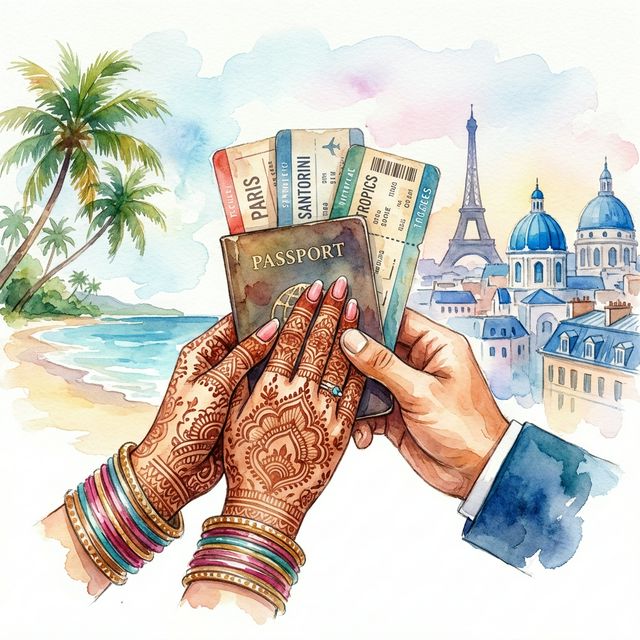
The Gifting Conversation Nobody Wants to Have
In Indian culture, wedding gifts have traditionally been straightforward. Cash in an envelope. Gold. Maybe a kitchen appliance set from the more practical relatives. Nobody needed a registry because everybody knew the system.
But things have changed. Many couples getting married today already live together. They already have a mixer grinder. They already have bedsheets. Their apartment doesn't have room for a fourth dinner set.
What they actually want is help funding their honeymoon to Bali, a down payment on a home, or simply cash to start their married life.
The problem? Saying "we'd prefer cash" feels... weird. At least to some people. And definitely to some generations. There's a gap between what couples actually need and what feels culturally comfortable to ask for.
A honeymoon fund bridges that gap. It gives guests a way to contribute to something specific and meaningful, without the couple having to say "just give us money, please."
Why Traditional Registries Don't Fit
Amazon and department store registries were designed for a specific scenario: a couple starting a household from scratch. Register for plates, towels, a stand mixer, a set of wine glasses.
For a lot of Indian couples, this doesn't apply. Many have been living independently for years. Some are combining two fully furnished apartments. The last thing they need is a third Instant Pot.
On the other hand, Indian families love giving generous, meaningful gifts. They want to contribute something that matters. A honeymoon fund gives them exactly that: the ability to gift an experience rather than an object.
"We contributed to their honeymoon in Santorini" feels better than "we got them towels" for the giver and the receiver.
How to Communicate It Without Awkwardness
The key to a successful honeymoon fund is in how you talk about it. Here are the principles that work:
Be warm, not transactional. "We're so grateful to have you at our wedding. If you'd like to give a gift, we'd love contributions toward our honeymoon adventure" lands very differently than "We're registered at [link]. Cash preferred."
Make it optional and pressure-free. "Your presence is the greatest gift" should be genuine, not just a line. The fund should feel like an option for guests who want to give, not an expectation.
Add specific items. Instead of just a blank "contribute any amount" box, break your honeymoon into experiences: "Sunset sailing in Santorini ($50)," "Cooking class in Tuscany ($75)," "Beachside dinner in Bali ($100)." This gives guests the feeling of giving something tangible, even though it's a cash contribution.
Put it on your wedding website, not the invitation. In Indian culture, mentioning gifts on the physical invitation card is generally considered poor form. But having a tasteful registry page on your wedding website that guests can find if they're looking? That's perfectly fine.
The Multi-Currency Reality
If your guest list spans multiple countries (and for most Indian weddings, it does), your gifting solution needs to handle different currencies.
Your relatives in India might want to pay in rupees via UPI. Your cousins in the US will use credit cards in dollars. Your friends in the UK will pay in pounds. Your uncle in Dubai will use dirhams.
This sounds like a small detail, but it's the kind of thing that can make or break whether a guest actually follows through on their generous impulse. If the payment page doesn't show their currency, if the conversion math is confusing, if the payment method they use isn't supported, the moment passes.
A good honeymoon fund platform handles this seamlessly. The guest sees a price in their currency, pays with their preferred method, and the couple receives the funds without worrying about conversion logistics.
What About the Shagun Tradition?
Cash gifts (shagun) are deeply embedded in Indian wedding culture. The amount is considered, often odd numbers ending in 1 (like 501, 1001, or 5001 rupees) because it's considered auspicious.
A honeymoon fund doesn't replace shagun. Many guests, especially older family members, will still give cash envelopes at the wedding itself. And that's beautiful. It's a tradition with deep meaning, and nobody should feel pressured to change it.
The honeymoon fund is for the guests who want to give digitally, who are traveling from abroad and don't want to carry cash, or who simply prefer the convenience of contributing online before the wedding.
Both can coexist. The envelope at the wedding and the online contribution before it. Let guests choose what feels right for them.
Setting It Up on Your Wedding Website
The best place for your honeymoon fund is a dedicated section on your wedding website. Not buried in the FAQ. Not a separate link to a third-party site. A clean, on-brand page that feels like a natural extension of your wedding experience.
On Phera, you can set up a honeymoon fund with individual items, descriptions, and target amounts. It sits right on your wedding website alongside your event schedule, RSVP, and travel information. Guests don't need to create an account anywhere else or navigate to an unfamiliar platform.
Payments are processed securely through Stripe, which means support for credit cards, debit cards, and major payment methods across countries. You receive the funds directly. No middleman taking a large cut.
The Gift Is the Celebration
At the end of the day, the best part of an Indian wedding isn't the gifts. It's the 400 people who showed up to celebrate with you. The dancing at the sangeet. The tears during the pheras. The cousins you haven't seen in five years being ridiculous on the dance floor.
The honeymoon fund is just a way to take some of that love and warmth and carry it into the next chapter. A dinner in Paris funded by your college friends. A dive trip in the Maldives made possible by your parents' friends. Experiences that carry the memory of all the people who celebrated with you.
Set up your honeymoon fund on Phera and let your guests contribute to your next adventure.