

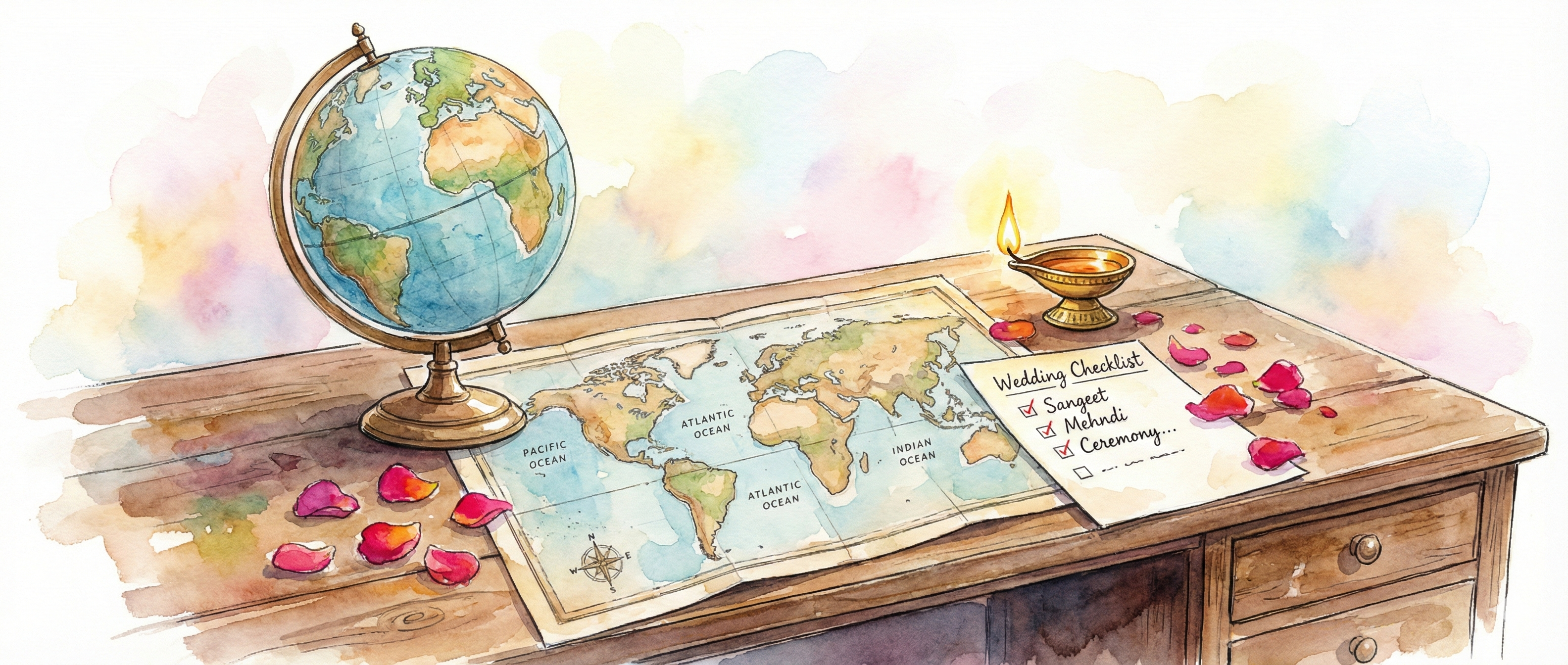
Your Guest List Is a Map of the World
You're getting married in Udaipur. Your parents are in Delhi. Your fiance's family is in Mumbai. Your college friends are scattered across Bangalore, Hyderabad, and Pune. Your cousins are in New Jersey, London, Toronto, and Dubai. Your grandparents are in the family home in a small town in Gujarat.
This is a completely normal Indian wedding guest list. And it makes planning exponentially harder than a wedding where everyone lives within driving distance.
The challenges aren't just logistical. They're cultural, financial, and emotional. You're trying to create an experience that feels authentic and joyful for your dadi who's never left India and your cousin who grew up in New Jersey and has never been to an Indian wedding this elaborate.
The Time Zone Juggling Act
When your wedding planner is in IST, your fiance is in EST, your photographer is in GMT, and your florist is in the same city as the venue but only available after 6 PM local time, scheduling a single phone call becomes a puzzle.
Now multiply that by every decision that needs input from people in different time zones. Outfit approvals from mom in Delhi at her convenience, which is your 3 AM. Venue walkthroughs over FaceTime at times that work for both coasts. Menu tasting notes relayed through voice messages because nobody could find a time to all be on the same call.
For NRI couples, this time zone complexity isn't an edge case. It's the default operating mode for months of planning.
A wedding website that's always accessible, always up to date, and doesn't require anyone to be online at the same time becomes essential. Your uncle in London can check the schedule at his convenience. Your aunt in Dubai can RSVP at hers. Nobody needs to wait for a WhatsApp reply at a reasonable hour.
Explaining the Multi-Day Format
If you grew up attending Indian weddings, a five-day celebration is just... how weddings work. But for guests who didn't, whether that's your fiance's non-Indian friends, your NRI cousins' partners, or colleagues you've invited, the multi-day format needs context.
"What's a mehendi?" "Do I need to come to the haldi?" "What does 'traditional attire' mean for someone who doesn't own Indian clothes?" "Is the sangeet like a rehearsal dinner?"
These are genuine questions from people who want to participate fully but don't want to get it wrong. They're not being difficult. They just need a guide.
Your wedding website should serve as that guide. Event descriptions that explain the significance of each ceremony. Dress code guidance that's specific enough to be helpful ("Think colorful and festive. Indian attire is wonderful if you have it, but a vibrant cocktail dress or suit works perfectly too."). A timeline that makes it clear which events are "you really should be there" and which are "come if you'd like to."
This isn't dumbing things down. It's welcoming people into a tradition they're excited to be part of.
The Accommodation Maze
Booking accommodation for a destination Indian wedding with international guests involves navigating at least three different comfort levels and budgets:
The family contingent from India: Likely to share rooms, prefer value-for-money options, might want to cook simple meals in the room. "Hotel mein kitchen hai kya?" is a real question you'll get.
The NRI relatives: Might want something nicer, will definitely comparison shop on Booking.com, and will have opinions about the hotel's Google reviews. Will ask about airport transfers and whether Uber works in the wedding city.
The international friends: Want clear, simple instructions. "Book this hotel, here's the link, here's the rate, here's the deadline." They don't want to navigate a hotel website in a language they don't read.
A single "Book your hotel here" link on your wedding website doesn't cut it. You need to be able to share different accommodation options with different price points, booking links, and context, all in one organized place that guests can reference any time.
Currency and Gifting Across Borders
The registry conversation gets interesting when your guests are in five different countries.
Your Indian relatives will likely give cash in envelopes (shagun). Your NRI relatives might want to transfer money digitally. Your international friends might want a traditional registry or a honeymoon fund.
Whatever you decide, being clear about it on your wedding website helps. "We're not registered anywhere, but if you'd like to give a gift, here's our honeymoon fund" is a perfectly reasonable thing to put on your site. It saves everyone the awkward "so... what do we get them?" conversation, especially for guests who aren't familiar with Indian gifting customs.
Travel Documentation Reminders
This one is specific but important. If you have international guests traveling to India for your wedding, gentle reminders about visa requirements, recommended vaccinations, and travel insurance can save someone a panic a week before the flight.
Not every American or British passport holder realizes they need a visa for India. Not every Indian relative traveling to a destination wedding abroad realizes their passport needs six months of validity. These are easy things to include on your wedding website's travel page, and they demonstrate genuine care for your guests' experience.
Making Everyone Feel Included
The emotional core of an NRI wedding is the coming together. Relatives who haven't seen each other in years. Childhood friends reconnecting. Grandparents meeting their grandchild's partner for the first time. Two families from different cities (or countries) blending their traditions.
Your wedding website and communication should reflect that warmth. It's not just a logistics tool. It's the first touchpoint that tells every guest, whether they're flying in from New Jersey or driving from the next town over, "We thought about you. We planned for you. We're so glad you're coming."
When your website clearly explains each event, provides practical travel information, respects different budgets for accommodation, and makes RSVPs easy regardless of tech comfort level, you're telling every guest that they belong at this celebration.
Build a Wedding Experience That Works Across Borders
If your guest list looks like a United Nations assembly, you need a wedding platform that's designed for exactly that kind of complexity.
Try Phera for free and build a wedding website that works for your dadi in Gujarat and your cousin in New Jersey.