

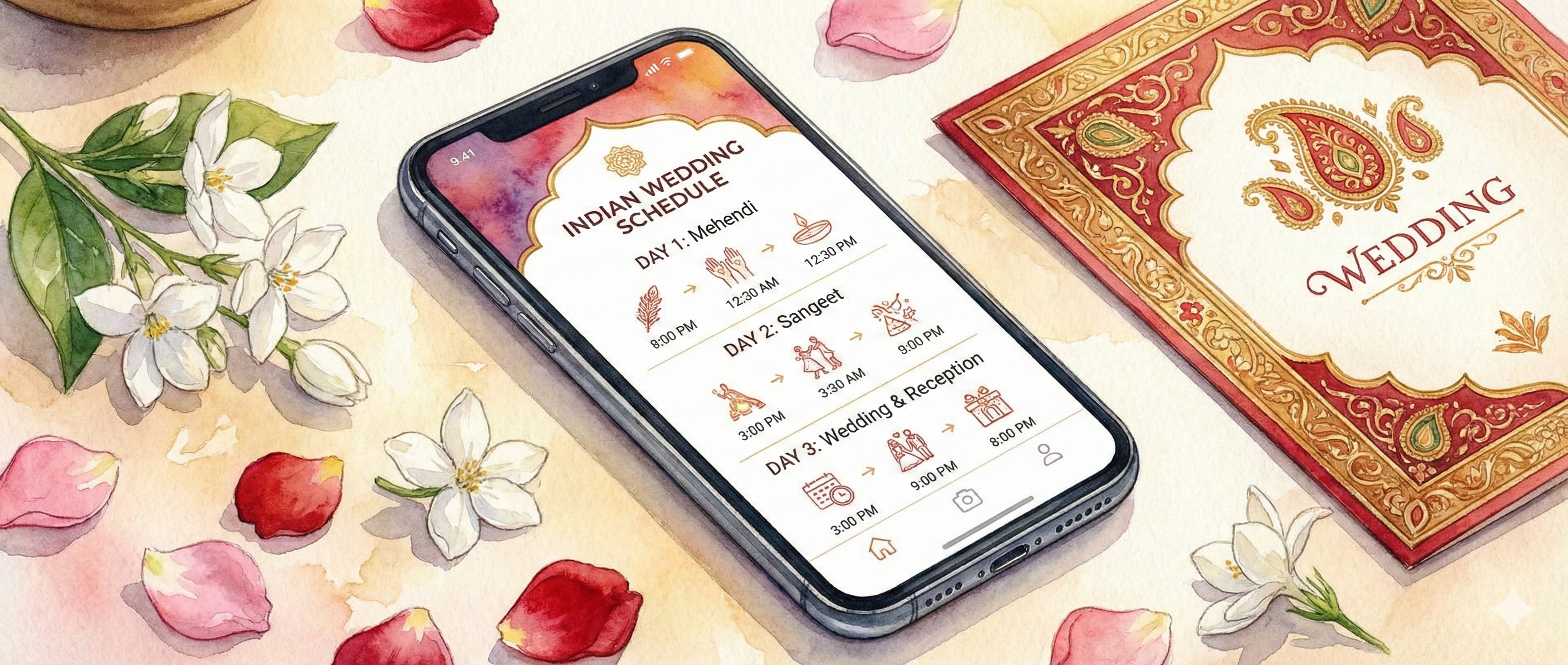
The One-Day Template Problem
Most wedding website builders were designed with a single question in mind: "When and where is the wedding?"
That's a perfectly reasonable question if your wedding is a Saturday ceremony at 4 PM followed by dinner and dancing. One venue. One dress code. One timeline.
Now try to answer that question for an Indian wedding:
- Thursday: Mehendi at the bride's family home, 2 PM to 7 PM, casual dress
- Friday morning: Haldi at the wedding venue, 10 AM, wear old clothes (it's going to get messy)
- Friday evening: Sangeet at the hotel ballroom, 7 PM to midnight, cocktail attire
- Saturday: Wedding ceremony, 11 AM auspicious muhurat, traditional Indian formal wear
- Sunday: Reception at a different venue, 6 PM, Indo-Western or formal
That's five events across four days with three venues, four dress codes, and varying guest lists. Try fitting that into a template designed for "Ceremony: 4 PM, Reception: 6 PM."
What Guests Actually Need to Know
When you send an Indian wedding invitation, the immediate response from every guest is the same: "Send me the details on WhatsApp."
And then begins the flood of questions:
- "What's the dress code for the sangeet?"
- "Is the haldi at the same place as the wedding?"
- "What time should we reach on Saturday? You said 11 but should we come by 10?"
- "Where is the parking?"
- "My mom wants to know if there's a shuttle from the hotel"
- "Can you send the Google Maps link again?"
You answer these questions once. Then again. Then ten more times. Then your mom starts answering on your behalf with slightly different information, and now guests are confused about whether the sangeet starts at 7 or 7:30.
A proper wedding website should be the single source of truth that you can send to anyone, any time, and it answers every question.
Multi-Event Schedules That Actually Work
Your wedding website should let guests see the full schedule at a glance. Not buried in a FAQ. Not hidden behind three clicks. Right there, clear and simple.
Each event should show:
- What: The name of the event (Mehendi, Sangeet, etc.)
- When: Date and time, including end time
- Where: Venue name and address, with a map link
- What to wear: Dress code with enough detail to be helpful ("Traditional Indian attire, bright colors encouraged" is better than just "Formal")
- Who's invited: Not every guest is invited to every event, and that's okay
When your cousin in California is trying to figure out if they need to book their flight for Thursday or Friday, they should be able to open the website and know in ten seconds.
Works for Dadi and Cousin Bhai
Here's something the Silicon Valley wedding website builders don't think about: your guest list includes people with wildly different comfort levels with technology.
On one end, your cousin bhai is going to open the link, scan it in two seconds, and add everything to his Google Calendar. On the other end, your dadi is going to receive the WhatsApp link, accidentally close it, ask someone to send it again, and then hand her phone to your younger cousin to "read it for her."
Your wedding website needs to work for both of them. That means:
- Fast loading. No 8MB hero videos that buffer on a 4G connection.
- Simple navigation. No hamburger menus, no infinite scroll, no "explore our love story" parallax animations.
- Large, readable text. Your dadi shouldn't need her glasses and a magnifying glass.
- WhatsApp-shareable. When someone shares the link in the family group, it should show a nice preview and open instantly.
- Mobile-first. 90% of your guests will open this on their phone. Design for that.
Replacing the Scattered WhatsApp Messages
Right now, the "system" for sharing wedding information in most Indian families looks something like this:
- Physical invitation card (beautiful, but has no details about the mehendi or travel)
- WhatsApp message from the couple with a Google Maps link
- Follow-up WhatsApp message correcting the timing from the first message
- Mom's WhatsApp message to her side of the family with different details
- Dad's phone call to his friends with yet another version
- A PDF itinerary that someone made in Microsoft Word and shared as a photo, so you can't even zoom in
By the time the wedding week arrives, no one is entirely sure what's happening when. And you'll spend the first day of celebrations answering the same questions you've already answered fifty times.
A wedding website replaces all of this with one link. One source of truth. Updated in real time. Accessible to everyone.
How Phera's Wedding Websites Handle Indian Wedding Complexity
Phera was designed from the ground up for multi-day Indian celebrations. Here's what that means in practice:
Multi-event support is built in. You don't create one event and hope for the best. You add each ceremony, function, and party as its own event with its own details, venue, dress code, and guest list.
Guest-specific views. When a guest opens the wedding website, they see the events they're actually invited to. No confusion about whether the mehendi is "for everyone" or "just close family."
Mobile-first, WhatsApp-ready. The website loads fast on any device and shows a clean preview when shared in WhatsApp. Because that's how your guests are going to receive it.
Per-event RSVPs. Guests confirm for each event individually. Your chacha can say yes to the wedding but skip the sangeet, and you'll know that when you're doing your headcounts.
Simple and warm. No over-designed templates that fight against Indian aesthetics. Clean layouts that let your details shine and feel welcoming to every generation of guest.
Your Wedding Deserves Better Than a Template
You're spending months planning a celebration that reflects your family, your culture, and your love story. Your wedding website should reflect that same care and attention to detail, not squeeze your five-day celebration into a template built for a four-hour event.
Try Phera for free and see what a wedding website built for Indian weddings actually looks like.